

OSAKA, Japan (AP) — Expo 2025 kicked off in
Osaka
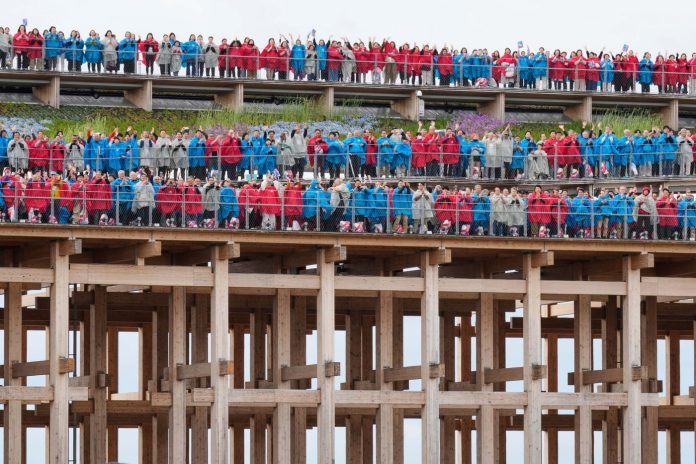
On Sunday, over 10,000 individuals gathered to sing Beethoven’s Ninth Symphony, marking the commencement of a six-month-long event aimed at bringing together a globe fractured by conflicts and wars, an initiative Japan hopes will foster unity.
Here’s what you should know about the Expo 2025 Osaka:
What does Expo 2025 Osaka entail?
The Osaka Expo takes place at Yumeshima, translating to “dream island,” a land created through reclaiming an old industrial wasteland within the waters of Osaka Bay. Here, over 160 nations, regions, and organizations exhibit cutting-edge displays across approximately 80 pavilions known for their distinctive architectural designs.
“Creating a future society for our lives” is the main theme. It is Osaka’s second Expo after the hugely successful 1970 event that attracted 64 million visitors, a record until Shanghai in 2010.

Event planners anticipate around 28 million attendees by mid-October; however, ticket sales have been sluggish, having only reached approximately 9 million pre-sales tickets, falling short of their original projection of 14 million.
“It has been 55 years since the previous Expo in Osaka. I’ve been eagerly anticipating this,” stated Daiki Chiba, who journeyed from Sendai, approximately 900 kilometers (560 miles) northeast of Osaka.
A lot of guests brought along Myaku-Myaku plushies or sported attire in harmony with its hues—red, blue, and white—to enhance their experience.
What is the significance of hosting an expo during times of worldwide tension?
The Expo occurs just four years following Japan’s challenge of hosting the Tokyo Olympics without spectators due to the coronavirus pandemic.

It begins amid trade conflicts and concerns about a potential worldwide economic decline triggered by U.S. President Donald Trump’s tariffs, spanning over a three-year period.
Russian invasion of Ukraine
and
Middle East conflicts.
Prime Minister Shigeru Ishiba
likened the worldwide tensions to “a national emergency” and warned that Trump’s tariffs, particularly the 25% levy on cars, would have detrimental effects across various sectors and could undermine Japan’s economy as a whole.
Nevertheless, Japan aims to transform the challenge into an opportunity.
I feel the timing is remarkably appropriate,” stated Sachiko Yoshimura, who leads global communications for Expo 2025. “Organizing the event now may ultimately aid in bridging divides across the globe. … This expo in Japan has the potential to foster enhanced international relations and progress.

What does the term Grand Ring refer to?

The iconic ring, designed by architect Sou Fujimoto, is a lattice-like structure encircling the venue and recognized by the Guinness World Records as the largest wooden architecture. It is 20 meters (65 feet) high and has a 2-kilometer (1.2-mile) circumference.

The costly ring takes up more than 14% of the Expo’s total spending of 235 billion yen ($1.64 billion) and has triggered public criticism.
The overall expense more than doubled compared to the original projection primarily because of the declining value of the Japanese yen, which also led to construction setbacks. Many exhibits, such as those presented by Nepal, India, Vietnam, and Chile, remained unfinished during the event’s inauguration.

The ring is designed to be partly recyclable, aligning with the concept of building a sustainable future.

What are other highlights?
Highlights include showcases of advanced tech gadgets like robots and airborne vehicles, alongside elements from popular culture such as Hello Kitty and Gundam.
Pavilions all appear stunning,” remarked Laurel Sylvester from New Zealand, who came accompanied by her spouse and two offspring. The family has an interest in marine conservation and had scheduled a visit to the Blue Ocean Dome. Laurel mentioned that her sons were “extremely thrilled about taking photos with the large Gundam robot and checking out some of the fascinating technological exhibits.

An artificially created miniature heart developed using induced pluripotent stem cells, known as iPSCs, showed signs of life beating at a healthcare exhibit in Japan. The Future of Life exhibition allows guests to engage with cutting-edge robotics. Additionally, an iconic human-powered laundry device that gained attention during the 1970 Expo has been reintroduced after receiving modern upgrades.

The United States Pavilion highlights themes of space exploration. The lunar rock from the Apollo 12 mission, which caused quite a stir during the 1970 exposition, was once again on exhibit.
China showcases soil samples from its lunar missions, with an emphasis on advancements in space technology.
Carrying a “Not for sale” sign and decorated with its blue-and-yellow national flags, Ukraine attracted many visitors with a globe and other items carrying barcodes. By scanning them, visitors can see videos showing people’s lives at war and their reconstruction effort.
Dmytro Lyuiy, the Ukrainian creative director, mentioned that his nation’s involvement remained uncertain until December because of the ongoing conflict. He stated that preparations were completed on Sunday morning, evident from the blue paint visible on his fingertips.

What is Myaku-Myaku?
The enigmatic, smiling entity known as Myaku-Myaku greets guests with its blue visage adorned by red circles, some of which resemble eyes.

According to the organizers, the mythical being came into existence through the merging of cells and water within a tiny spring located in the Kansai area. This amiable yet awkward figure has the ability to change into different forms and excels at discovering a rainbow following rainfall.
___
Yamaguchi reported from Tokyo.
Ayaka McGill and Mari Yamaguchi, The Canadian Press